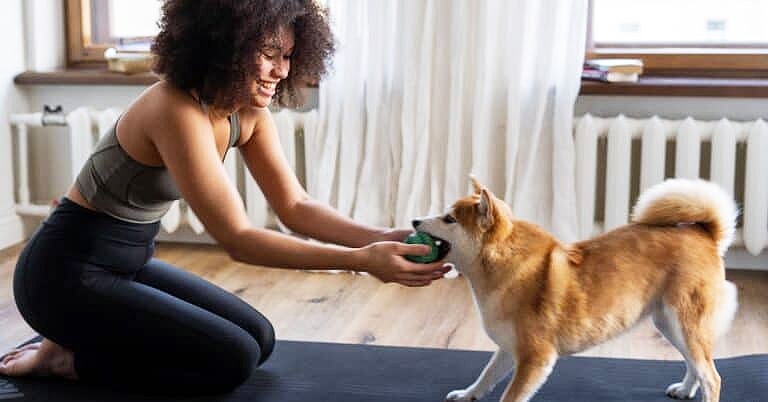
There are many benefits of positive reinforcement dog training. For dog owners, positive reinforcement can mean a lot of things. It can mean training your dog to obey you. Or it can mean training them not to bark or to leave a room. This article will show you why it is important to train your Shiba Inu with positive reinforcement.
Positive reinforcement builds a strong bond between you and your dog. Without that bond, your pet can resist good behaviors, such as staying away from the doggie door, sleeping in a crate, or getting attention for good behaviors.
Positive reinforcements, especially those that come in the form of treats and toys, help break through those barriers. Eventually, the dog will become comfortable with the consequences of his actions, and obedience will become more likely.
Of course, you have to be careful when using positive reinforcement. There is a big difference between punishing your dog for bad behavior and rewarding him for good behavior.
When I am working with a particularly challenging dog, I never use punishment. Instead, I prefer to reward my pets with praise whenever they exhibit good behavior. (This technique, called positive reinforcement, actually works even if your pet doesn’t display any actual bad behavior.)
When you use positive reinforcement for dog training, you don’t need to resort to punishments. You can teach him how to obey by simply giving him training rewards when he performs the behaviors that you want him to perform.
As an example, if you want your pet to come when the doorbell rings, you simply praise him when he goes in the door. (As an added bonus, you may want to keep a few of these treats on hand because they are very tasty and your dog will love them!) Your dog will learn that performing the desired behaviors will earn him rewards.
Of course, you have to use positive reinforcement correctly. For instance, it would be completely inappropriate to reward your puppy for begging when he has just urinated. If you do this, you will only be setting your dog up for failure.
That’s why you should only give your dog positive reinforcement when he is demonstrating good behavior. But you also need to know when to give him praise, in order to teach your pet the appropriate behaviors.
When you are rewarding your pet for positive reinforcement training, it is important that you praise him consistently. Dogs are very sensitive to praise and positive reinforcement.
They actually crave it! If you only praise him every time he exhibits a desirable behavior, you set yourself up for failure. Your dog will learn to expect that every time he gets a positive reward, he will get a positive reward.
Positive reinforcement means rewarding the exact behavior you want the instant it happens, so the dog learns that choice pays and repeats it, and for a self-interested breed like the Shiba Inu it is both the most effective and the most durable approach. You are not bribing the dog, you are building a track record: every time cooperation earns something good, the behavior gets stronger. The two things that make or break it are timing, marking the behavior at the precise moment it occurs, and value, paying with something the dog actually cares about. Done well, this produces a Shiba that offers behaviors willingly rather than one that complies under pressure and looks for the exit. Punishment and force cut the other way, teaching an independent dog to avoid, resist, or shut down. Reward the right choices consistently and you get a dog that wants to work with you, which is the whole point.
The short version, in four parts:
- Timing is everything. Mark the behavior the instant it happens, then deliver the reward, so the dog connects the two.
- Value has to match the ask. Pay boring behaviors cheap and hard ones with something a Shiba truly wants.
- Set up wins. Arrange things so the right behavior is easy, then reward it, rather than waiting to correct mistakes.
- Fade food, keep behavior. Once a skill is solid, move to intermittent rewards, which actually makes it stronger.
How to train your Shiba Inu with positive reinforcement
The Shiba Inu breed responds poorly to punishment or negative reinforcement training techniques. And if you want to build a bond with your Shiba, it is best to figure out ways and work on building trust between you and your dog.
Since positive reinforcement requires praising or giving your dog treats when they are behaving in the way you want to, it might help that you feed your Shiba Inu with kibble-based food. This is a very easy way to keep on rewarding them treats but still maintaining a controlled diet.
However, Shiba Inus will be underwhelmed that they are still receiving their normal diet when they’ve been acting particularly good to you. So during training, you might want to deviate from their normal diet and try something extra special.
The most important thing to remember is that Shiba Inu can be quite sensitive so make sure that you are training them for success by keeping your sessions short and sweet and always finish with cheer and positivity. For example, by the end of your session, revert back to commands that your dog has already mastered and rewarding them.
You may have to experiment with different rewards and positive reinforcement techniques to find what works best with your pet. The key is to make sure that your pet receives all the positive reinforcement he needs, but without getting him confused with harsh punishment.
As long as you are consistent, you will be able to control behavior through rewards and positive reinforcement. Just remember that you are praising your dog for good behaviors. Your goal is to create a positive environment in which your pet can thrive.
How positive reinforcement actually works with a Shiba
Positive reinforcement is simple in principle and easy to fumble in practice, and Shibas are unforgiving of sloppy mechanics because they will not work through confusion for you. Get these six elements right and the method does the heavy lifting.
- Mark, then reward. Use a consistent marker, a clicker or a word like "yes," at the exact instant the dog does the right thing, then follow with a treat. The marker bridges the gap between the behavior and the reward so the dog knows precisely what earned it. Late or vague marking is the most common reason training stalls, because the Shiba connects the treat to the wrong thing.
- Set the dog up to succeed. Capture behaviors the dog offers on its own, lure with a treat, or shape in small steps, and arrange the environment so the right choice is the easy one. You want to reward correct behavior constantly, not sit around waiting to correct mistakes. A Shiba that is winning stays in the game.
- Use high-value rewards, tiered. Match the pay to the difficulty. Kibble for easy known behaviors, soft training treats for new skills, and real meat or cheese for hard asks and distracting places. Our roundup of the best training treats for a Shiba Inu covers what to keep in each tier.
- Keep criteria clear and the rate high. Raise difficulty one step at a time and reward often, especially early. If the dog fails twice in a row, you asked for too much, so make it easier and rebuild. Shibas quit when the criteria jump faster than the reward justifies.
- Fade the food without losing the behavior. Once a behavior is reliable, shift to rewarding intermittently and mix in praise and life rewards like access to a sniff or a door. Counterintuitively, an unpredictable reward schedule makes a learned behavior more durable, not less. The goal is a Shiba that responds because the habit is built, not because it audited your hand first.
- Skip the punishment. Aversive corrections and dominance tactics suppress behavior through fear and tend to make an independent Shiba defensive or shut down, and they can convert fear into aggression. Reward-based training builds the cooperation you want without that cost. This is the method every good breed-honest owner should default to.
One owner insisted positive reinforcement "did not work" on their Shiba. Watching a session, the problem was obvious: they were saying "good boy" a full two seconds after the sit, then digging in a pocket for a treat, so the dog had already stood up and wandered off by the time the reward arrived. We added a clicker to mark the exact moment and pre-loaded treats in hand. The same dog was learning new behaviors within one session. The method was never broken, the timing was.
What we have seen across the pack
Across 250-plus Shibas placed since 2019, reward-based training is the through-line in nearly every success, and the failures usually trace to mechanics rather than the philosophy. Owners who mark late, pay with rewards the dog does not value, or jump criteria too fast conclude the method failed when they simply ran it poorly. When the timing tightens and the value matches the ask, even famously stubborn Shibas come along. This breed is a good teacher in that way, it exposes lazy technique fast, because it will not paper over your mistakes with eagerness to please.
The honest limit is the same one that applies to every method: reward-based training teaches a dog what to do, but it is one part of a plan when the real issue is how a dog feels. Fear, reactivity, and separation anxiety need desensitization and counterconditioning, and often a credentialed trainer or veterinary behaviorist, on top of good reward mechanics. Positive reinforcement is the foundation those plans are built on, not a substitute for them. When an owner is grinding away and not getting traction, we look at whether the mechanics are off or the problem is emotional. Our one-on-one training starts by watching a real session, because a two-second timing fix often unlocks weeks of stalled progress.
Related questions
Does positive reinforcement really work on stubborn Shibas?
Yes, and it is the most effective approach for the breed precisely because it works with a Shiba's self-interest instead of fighting it. When people say it failed, the cause is almost always mechanics: late marking, low-value rewards, or criteria raised too fast. Tighten the timing, pay with something the dog values, and keep sessions short, and even stubborn Shibas cooperate.
Do I need a clicker for positive reinforcement training?
No, but a marker of some kind helps enormously. A clicker gives a precise, consistent signal at the exact moment of the behavior, which sharpens the dog's understanding. A short verbal marker like "yes" works too, as long as you use it consistently and immediately. The tool matters less than marking the right instant every time.
Will I have to give my Shiba treats forever?
No. Food is heavy early because it builds the behavior efficiently, but once a skill is reliable you fade to intermittent rewards and fold in praise and real-life rewards. An unpredictable reward schedule actually strengthens the behavior. You will always want to reinforce occasionally to keep it strong, but you will not be luring your dog with a treat for every sit.
What to read next
Apply this across the whole plan with our Shiba Inu training overview, stock the right rewards with our training treats roundup, and build confidence early with how to socialize a Shiba Inu. When you want hands-on help refining your timing, our one-on-one training is built for the breed.
Looking to adopt or rehome a Shiba?
Rescue-first rehoming with vetted families, 1-year health guarantee, lifetime support.