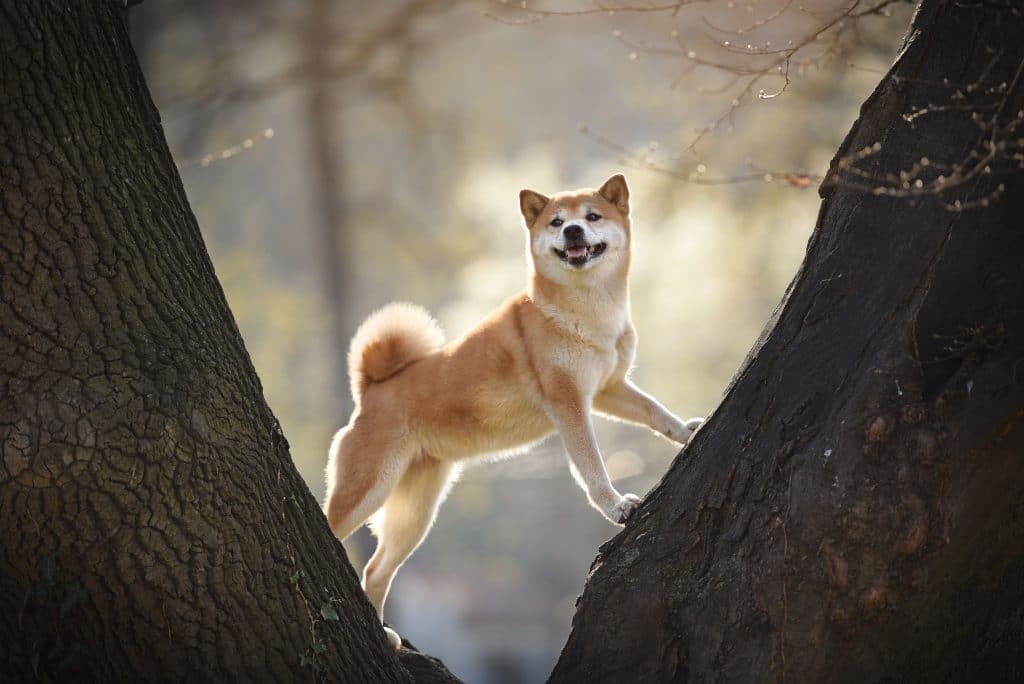
Both Shiba Inus and Akitas are Spitz dogs, and are ancient breeds of Japan. They look similar in appearance, looking fox-like, friendly, and proud. What are the differences between the two?
The Shiba Inu and the Akita are both ancient Japanese spitz breeds that look alike, but the Akita is a large guardian dog and the Shiba is a small hunting companion, and a "Shibakita" is a cross of the two. Same country, same fox-like silhouette, very different dogs. An Akita can top 100 pounds and was bred to guard, while a Shiba weighs around 20 and was bred to hunt small game in the brush. The Shibakita is not a recognized breed but a crossbreed whose traits land somewhere between its parents, which is exactly why knowing both breeds matters before you take one on.
The short version, in four parts:
- Both are ancient Japanese spitz breeds with upright ears, curled tails, and independent minds.
- The Akita is large and guardian-bred; the Shiba is small and hunting-bred.
- The Shiba tends to be friendlier to strangers and other dogs; the Akita is more reserved and dog-selective.
- A Shibakita is a crossbreed, so its size and temperament vary with which parent it favors.
Introducing The Shiba Inu’s Friendly Cousin, The Akita
Everyone loves Shibas; but in recent years the Shiba Inu’s cousin, the Akita, has gained a lot of popularity. And in our opinion, this popularity is very well-deserved.
These Japanese canines, while sharing a lot of similarities, are also quite different from each other.
Akitas were bred for mostly one purpose, to guard and protect. On the other hand, Shibas were bred to be loyal companions and cuddle buddies.
The differences between Akitas and Shiba Inus
Both these Japanese dog breeds look similar, but differ in size and weight. Along with that, they possess completely different attitudes. Here are a few things you should know about how they differ:
Akita Size
Akitas are the big boys among these two breeds. They grow as tall as 28 inches, whereas Shiba Inus only grow up to 16 inches.
The females of both these breeds are a bit smaller, compared to their male population.
How They Look
Well, obviously Akitas look bigger and stronger.
They both have symmetric faces and pointy ears. Akitas come in different shapes, whereas the same cannot be said about the Shibas.
Akitas can be sesame, white, red fawn, or brindle and often have black coloration on their face. You can get a Shiba Inu in tan, black, or red.
Their Temperament
Both these dogs are as loyal as they come. However, Akitas have stolen the limelight recently, thanks to the movie Hachi: A Dog’s Tale.
Akitas are active, intelligent, and brave dogs. Shibas are independent, loving, and mischievous dogs.
Ability to be Trained
These two dog breeds are both capable of being trained, although Shibas are known to be difficult at times.
Since Akitas are intelligent dogs, you don’t have to put in a lot of effort to train them. They’re smart enough to understand what you’re trying to teach them.
You can go hard on Shibas, while training them. But, don’t give out any aggressive vibes to Akitas, they don’t like it that way.
Health Attributes
All dogs are prone to certain health problems. The Inu cousins are no exceptions here.
Due to their large size, Akitas are prone to health issues such as malformed joints, eye issues, clotting disorders, and a few such.
Shiba Inus may suffer from hip dysplasia, glaucoma, and kneecap issues among others.
Grooming Needs
Both these breeds are blessed with thick and fluffy coats. However, you won’t feel as blessed as them, since thicker coats require more grooming.
Cleaning their ears, clipping the nails, and bathing them regularly should do the job.
Life Expectancy
Thanks to their compact and cute little bodies, Shiba Inus on average outlive Akitas.
The average life expectancy of an Akita is 10-12 years, whereas it can go as long as 12-16 years with Shiba Inus.
If you adopt a crossbreed of the two dogs, it goes by the name Shibakita. Therefore, it is a good idea to know a little bit about these two Japanese breeds if you bring a Shibakita into your household. The traits the dog possesses will depend which characteristics are more pronounced of the two purebred dogs.
Japanese Breeds
Both the Shiba and Akita belong two Japan’s indigenous breeds of dogs, including breeds, such as the –
- Hokkaido
- Kai
- Tosa
- Shikoku
Shibakita Traits
The Akita represents the largest Japanese dog breed while the Shiba Inu represents the smallest breed. Therefore, the Shibakita is often medium in size. However, both dogs share these traits:
- High intelligence
- Affectionate
- Independent
- A little bit stubborn, at times
- Same type of coat – soft undercoat and coarser overcoat
- Body and tail shape
- Predatory instinct, as both dogs were used for hunting
- Both obsessive-compulsive about cleaning themselves
While the above traits forge a bond between the two breeds, there are some differences as well. For example, of the two breeds, the Shiba Inu tends to be more friendly than the Akita – both toward humans and other pets.
A Loyal Companion Dog
While an Akita can still be considered a loyal companion dog, it usually is not a natural friend to strangers, kids, or cats. However, the Akita will safeguard its family, or the ones he loves. In addition, because it once was used as a fighting dog, the Akita acts more aggressively toward other dogs.
On the other hand, the Shiba shows more tolerance toward other dogs. Also, for anyone living in a small space, the Shiba, because of its smaller size, can adapt better. Therefore, the Shiba can be integrated into a smaller place, such as an apartment. That is the reason the Shiba is a popular apartment pet in Japan where space is at a premium.
The Akita dog, however, needs extra space to run and exercise. Plus, the Akita has problems being left alone. Even though it is independent by nature, it does not like being cooped up all day and left by itself. Therefore, it is hard to say how a Shibakita might respond in a similar situation. The dog’s reaction depends on which one of its parent’s traits it tends to possess.
Obedience Training – Why You May Need a Trainer
When it comes to dog obedience training, both the Akita and Shiba Inu require a strong trainer – someone who instills positive reinforcement in his or her dog training protocol. In addition, you need to practice some passive resistance when training either dog, as both pooches have stubborn tendencies. If you don’t consider yourself a natural “leader of the pack,” you should take time out to schedule dog obedience training for an Akita or Shiba, or a Shibakita.
An Escape Artist
With that said, the Shiba Inu is an easier dog to raise than the Akita. Again, the Akita is larger and more aggressive, so it will vocalize more than its smaller counterpart. Also, Akitas can be escape artists, and can figure out ways to get under or over a fence if confined to their yard.
Basic Differences
The Akita stands from 24 to 48 inches tall while the Shiba Inu stands between 13 to 17 inches in height. Akitas may weight anywhere between 70 to 130 pounds while a Shiba weighs about 22 pounds. Akitas may drool while a Shiba will not do it.
Usually, smaller dogs live longer than large dogs. This also holds true for Akitas and Shiba Inus. Typically, a Shiba will live about 16 years, or four years longer than an Akita, which lives around 12 years. When it comes to shedding, both dogs blow fur. However, the Shiba sheds less than the Akita because it is smaller.
Medical Conditions
As the dogs age, the Akita is more prone to suffer from conditions, such as elbow dysplasia or hip dysplasia. These medical concerns are marked by deformities around the joints and bones. Both dogs, as they get older, may experience progressive retinal atrophy. This condition can lead to a loss of vision because of retinal degeneration.
While some health concerns are genetic in nature, it does not mean you cannot anticipate some of these conditions and provide a Shiba Inu, Akita, or crossbreed, such as the Shibakita, a quality life. By preparing raw dog recipes and enforcing optimum dog nutrition, you can maximize our dog’s health and make it comfortable in its old age.
Both the Akita and Shiba Inu think independently and show affection to their owners and families. However, again, the Shiba is normally friendlier to newcomers. Still, you cannot narrow either dog’s demeanor to traits alone. You also have to consider your own treatment and care of your companion dog. If you show your dog that you can be trusted and be a good “pack leader,” you will raise a terrific canine, regardless of the breed.
Which would you choose: A Shiba Inu, Akita, or Shibakita?
What is your favorite Japanese dog? Do you think that you could own a Shibakita? Or, would you rather adopt an Akita or Shiba Inu? What are your views on these dog breeds? Do you think the Shibakita should be considered a designer dog? Would you get a personal trainer to help you train any of these independent and strong-minded dogs?
Shiba, Akita, or Shibakita: how to choose
These three are not interchangeable, and picking the wrong one for your life is how dogs end up needing rehoming. Here is the framework we would walk a prospective owner through.
- Space and size. A Shiba fits an apartment; it is small, adaptable, and popular in dense Japanese cities for that reason. An Akita is a large, powerful dog that wants room to move and does poorly cooped up. A Shibakita lands in between, but you should plan for the larger end until the dog proves otherwise.
- Sociability. The Shiba is generally friendlier toward strangers and more tolerant of other dogs. The Akita is a devoted guardian that is often reserved with strangers and dog-selective, a legacy of its guarding and fighting past. Neither is a Labrador, but the Shiba is the more flexible of the two.
- Trainability and handling. Both are intelligent and both are stubborn, so both reward patient, positive, consistent training. The Akita in particular does not respond well to heavy-handed methods. Either dog benefits from an owner comfortable being a calm, clear leader, and either may need a professional trainer.
- Exercise and containment. The Akita needs more exercise and space, and both breeds have a prey drive and a talent for escaping a yard. Secure fencing and reliable management matter for all three, and offleash freedom is rarely safe with any of them.
- Health and lifespan. Smaller dogs tend to live longer, and the Shiba's typical lifespan runs several years beyond the Akita's. Each breed carries its own risks, with joint and eye conditions common in both, so budget for lifelong veterinary care regardless of which you choose.
- The Shibakita variable. A crossbreed is a genetic coin flip. A Shibakita can favor its Akita parent's size and guardedness or its Shiba parent's compactness and sociability, and you will not know for sure until the dog matures. Adopt one only if you are prepared for either outcome.
A composite of how this decision goes wrong: someone charmed by an Akita's Hachiko loyalty adopts one into a small apartment with no yard, and the mismatch between a large guardian breed and a cramped space becomes untenable within a year. The breed was not the problem, the fit was. For a fuller temperament breakdown, our Shiba Inu breed guide covers the smaller cousin in depth, and our honest guide on whether a Shiba Inu is right for you helps you decide before you commit.
What we have seen
Across 250+ Shibas placed since 2019, we mostly work with Shibas, but the Shiba-versus-Akita confusion comes up constantly, and it matters. People fall for the look, blur the two breeds together, and end up surprised by the dog they actually got. An Akita is not a big Shiba and a Shiba is not a small Akita. They are related, not interchangeable, and the differences are the whole point.
The Shibakita question comes up too. Owners who took on a crossbreed expecting a predictable middle-ground dog sometimes got a full-sized, guardian-tempered animal instead, and vice versa. With any crossbreed the honest answer is that you are adopting a range of possibilities, not a fixed spec. That is fine if you go in clear-eyed and a problem if you were counting on a specific outcome.
What has worked: matching the actual dog in front of us, not the breed label, to the actual home. What has not worked: assumptions based on looks. Whichever of these dogs you have, both breeds reward real training, so our one-on-one training is built for exactly these strong-minded Japanese breeds, and a certified trainer is worth it for an Akita, a Shiba, or the cross.
Common followup questions
Are Shibas and Akitas the same breed?
No, they are separate breeds that happen to be related. Both are ancient Japanese spitz-type dogs, which is why they share the upright ears, curled tail, and fox-like face. But the Akita is large and guardian-bred, the Shiba is small and hunting-bred, and they were developed in different regions for different jobs. Looking alike is not the same as being the same.
Which is easier to own, a Shiba or an Akita?
Generally the Shiba, mostly because of size and adaptability. A Shiba fits smaller homes, is friendlier to strangers and other dogs, and is physically easier to manage. An Akita is a large, powerful, more reserved guardian that needs more space, more careful socialization, and confident handling. Neither is a beginner dog, but the Shiba is the more forgiving of the two.
Is a Shibakita a good dog?
It can be, if you accept the uncertainty. A Shibakita crosses the smallest and largest Japanese breeds, so its size and temperament depend on which parent it favors and cannot be predicted in advance. A well-raised Shibakita is intelligent, loyal, and independent like both parents. Just adopt one ready for either a compact, social dog or a larger, more guarded one.
What to read next
For a deeper look at the smaller cousin, read our Shiba Inu breed guide and the history of the Shiba Inu. If you are weighing whether the breed fits your life, our honest guide on whether a Shiba Inu is right for you is the next step, and our one-on-one training helps with either of these strong-willed breeds.
Looking to adopt or rehome a Shiba?
Rescue-first rehoming with vetted families, 1-year health guarantee, lifetime support.