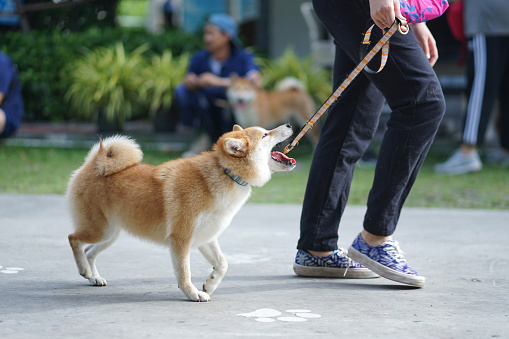
A peaceful walk downtown with your Shiba Inu is an enjoyable pastime that you both would definitely love. Running errands and eating out together are excellent ways to build a bond with your pets.
That is if they know how to behave in public.
The outside world is an exciting environment for your Shiba Inu and an excited dog, all jumpy and distracted, is not exactly a fun experience. Remember, your dog’s unruly behavior is your responsibility. If your Shiba Inu happened to jump at a person and injure them, there’s a high chance you will be held liable for their medical expenses.
But, if you have a well-behaved dog that knows how to remain calm even in the most stimulating situation, going out in public will be a pleasurable adventure for you and your Shiba Inu.
You train a Shiba to behave in public by building the skills at home first, then adding distraction in small, rewarded steps until busy places feel normal. A Shiba that cannot sit, focus, and walk on a loose leash in your living room has no chance on a crowded sidewalk, so the foundation comes before the field trip. From there it is graduated exposure: quiet streets before parks, parks before patios, always working at a distance where your dog can still think. Reward calm attention, manage the breed's prey drive on leash, and never flood a nervous dog into a chaotic environment. Public manners are a trained skill, not a personality trait, and Shibas can absolutely learn them.
The short version, in four parts:
- Build focus, sit, and loose-leash walking at home before going out.
- Add distraction gradually: quiet spots first, busy ones much later.
- Reward calm attention and keep enough distance to stay under threshold.
- Manage prey drive and reactivity on leash. Never force a scared dog in.
How to Train your Shiba Inu to Behave in Public
A well-behaved dog didn’t happen overnight. To restrain itself from going berserk at new sights and new smells, it underwent consistent obedience training.
And your Shiba Inu can do this too! With time, patience, and positive reinforcement, a walk out to town can be a piece of cake for you and your dog.
Teach basic obedience
When your Shiba Inu has fully mastered basic obedience commands, then he is fifty percent ready to go out in public.
Obedience commands like sit, stay, and leave, allow your dog to understand how they should behave outside. They are helpful in different situations like exploring new places or meeting new people.
When you consistently train them, they are bound to get less distracted and more attentive to you and your commands.
Introduce your Shiba Inu to new experiences
When you’ve socialized your Shiba Inu as a puppy to be comfortable around new and unfamiliar objects, bringing him outside in public or stores will be easier.
The mall, for example, is full of strange objects your dog will be interested in, such as carts with wheels. But with training, you’ll find that your Shiba Inu can be the calmest dog even in the presence of wheels.
First, introduce the object from afar. Train your dog to remain calm with positive reinforcement and gradually get the object closer. You can also use different items that you know your dog might get distracted in, such as strollers or skateboards.
Choose appropriate equipment
There are a lot of collars and harnesses available in the market and each has its pros and cons. So you have to choose one that is safe, comfortable and lets you control your dog.
For smaller dogs that have delicate necks, a body harness is often the best choice. But if you must choose a leash, make sure it is sturdy and comfortable for you to hold.
Burn off excess energy
Excess energy can lead to overstimulation and anxiety, and this is not a good combination if you are planning to bring your Shiba Inu somewhere exciting.
So before heading out to town, make sure to burn off some of your Shiba’s extra energy. Take a brisk walk or jog, play extensive games like fetch, and get them physically active and hydrated.
Offer better rewards
The new public environment can bring either fright or excitement to your dog. They’ll be tempted to jump and bark at people, or cower and fear them.
One way you can overcome this kind of situation is to offer better rewards for good behavior.
If your Shiba Inu is motivated by food, bring their favorite treats with you. Once they are displaying good behavior, give them treats so they know they are doing a good job.
Same with play-motivated and praise-motivated dogs. Bring their favorite toy and frequently praise them for being well-behaved.
Be attentive
Your dog is your responsibility. And even though this mainly refers to you being liable if your dog reacts badly in public, it also means you should be attentive to what your dog is feeling.
Keep an eye on your Shiba Inu and observe their body language. If they are showing signs of distress, move them to a calmer area and offer rewards.
Not every dog is a happy dog just because they are off to adventures with their parents. Some are just scared and anxious about the new sights and smells, but this is nothing training can’t fix!
The path from living room to Main Street
Public manners are built in stages, and skipping ahead is why so many outings go sideways. Work through these in order, and only move up when the current stage is easy.
- Foundation at home. Teach name recognition, sit, a solid "focus" or "watch me," and loose-leash walking where there are no distractions. These are the tools you will lean on everywhere else. If they fall apart at home, they will not exist downtown.
- Low-distraction outdoors. Practice the same skills in your yard, then a quiet street. The goal is to keep your dog able to respond while the world gets a little more interesting. Reward heavily for checking in with you.
- Graduated exposure. Work up through quiet parks, then busier ones, then the edges of shopping areas, always at a distance where your dog can still take a treat and think. Pushing too close too soon puts the dog over threshold, where no learning happens.
- Impulse control. Add "leave it," a reliable "settle" on a mat, and polite greetings (or a clean pass-by). These are what turn a dog that tolerates public into a dog that is genuinely easy in public.
- Manage prey drive and reactivity. Shibas carry real prey drive, so squirrels, cats, and skateboards will test you. Keep the leash secure, reward disengagement, and increase distance from triggers rather than correcting the reaction. For dogs that react to other dogs or people, this is where you go slow.
- Proof it. Practice in short, successful outings and end before your dog is fried. Ten good minutes beat an hour that ends in a meltdown. Frequency and success build the habit.
Consider a young Shiba we worked with who "hated" downtown, lunging and spinning on the leash. The owner had jumped straight from backyard to a farmers market. We backed all the way up to quiet streets, rebuilt focus and loose-leash walking, and rationed the exposure, and within a couple of months the same dog could hold a settle at a cafe. Nothing was wrong with the dog, the training just skipped the middle. Loose-leash skills are the backbone of all of this, covered in how to loose-leash walk your Shiba Inu, and if your dog is genuinely reactive to other dogs rather than just excited, our Shiba Inu aggression guide is the deeper read.
What we have seen across 250+ placements
Since 2019 we have placed more than 250 Shibas, and the number one reason public training fails is people rushing the difficulty. Owners want the dream (a dog snoozing under a brunch table) and try to skip straight to it, which sets both dog and human up to fail. The Shibas who become great public dogs got there through boring, incremental practice, not big outings.
The second thing we see is owners under-managing prey drive and over-trusting recall. This breed is not a golden retriever, and even a well-trained Shiba can blow you off for a squirrel. The dogs who stay safe in public are the ones whose owners respect that and keep them leashed and set up to succeed, rather than testing off-leash reliability that Shibas famously do not have.
The place to get help is reactivity. There is a real difference between an excited dog who pulls toward everything and a fearful or reactive dog who lunges, barks, and cannot settle near other dogs or people. Excitement responds well to the staged plan above. True reactivity or fear needs a certified trainer, and sometimes a veterinary behaviorist, working a proper behavior-modification protocol. Our breed-specific 1-on-1 training is built for exactly this progression, from foundation skills to confident public outings.
Common followup questions
Can a Shiba Inu be trusted off-leash in public?
As a rule, no. Shibas have strong prey drive and independent recall, meaning even a well-trained one may bolt after a squirrel and ignore your call. Most experienced owners keep them leashed in any unfenced public space, full stop. Off-leash reliability is the exception, not the goal, and betting a dog's life on it is not worth it.
How do I stop my Shiba lunging at other dogs on walks?
First, figure out if it is excitement or reactivity, because they need different plans. For both, increase distance so your dog stays under threshold, reward him for noticing the other dog and looking back at you, and avoid tight, head-on passes. If it is fear or aggression based, loop in a certified trainer rather than trying to correct the lunging away.
Are Shibas good candidates for cafes and patios?
Many can be, with training. A Shiba that has learned a solid settle and is comfortable with the environment can be a lovely patio companion. Build up to it: start when it is quiet, bring a mat and a chew, keep sessions short, and leave before the dog gets restless. Do not expect a green dog to nap through a busy brunch on day one.
What to read next
Loose-leash walking underpins every public outing, so read how to loose-leash walk your Shiba Inu, and how to socialize a Shiba Inu covers building comfort with the wider world. If jumping on people is part of the problem, stopping your Shiba from jumping helps, and when you want a structured progression, our 1-on-1 training programs are built for the breed.
Need help training your Shiba?
Long-term behavior modification and skill training, built for the breed.