
Crate training is a method to house train dogs or puppies and is also a method that requires a lot of time and effort. Of course, all hard work reaps positive outcomes and crate training keeps your dog safe and confined when you are not nearby to supervise.
There are a lot of reason why you should crate train your dog. For example, it is useful in a variety of situations like sleep urinate or excreting, limit house access and executing house training, such as things he can and can’t chew. Another one of its uses is traveling. The crate will serve as the dog’s safe place if you happen to arrive at your destination and your dog is not welcome to run or walk freely.
When properly executed, crate training will allow your dog to understand many things, such as preventing it from acquiring bad habits of creating a fuss at home and will also think that their crate is their relaxation and safe place.
Successful crate training comes down to one principle: the crate has to become a place your dog chooses, built through slow, positive association and never once used as punishment. You are not putting a dog in a box, you are teaching it that the box is the safest, most relaxing spot in the house. With a Shiba, that means going slower than you think you need to, paying generously for calm, and resisting the urge to rush to a closed door and a full day alone. Push too fast and an independent, easily frustrated breed learns the crate means being trapped, which is far harder to undo than to prevent. Done right, most dogs come to walk into the crate on their own.
The short version, in four parts:
- Association first. Feed meals and drop treats inside so the crate predicts good things before the door ever closes.
- Duration on a curve. Build from seconds to minutes to hours, always ending before the dog gets anxious.
- Never a punishment. The crate is a den and a rest spot, never where you send a dog in anger.
- Read the difference. Settling whining fades; panic escalates, and panic is a signal to slow down or get help.
How to select a dog crate?
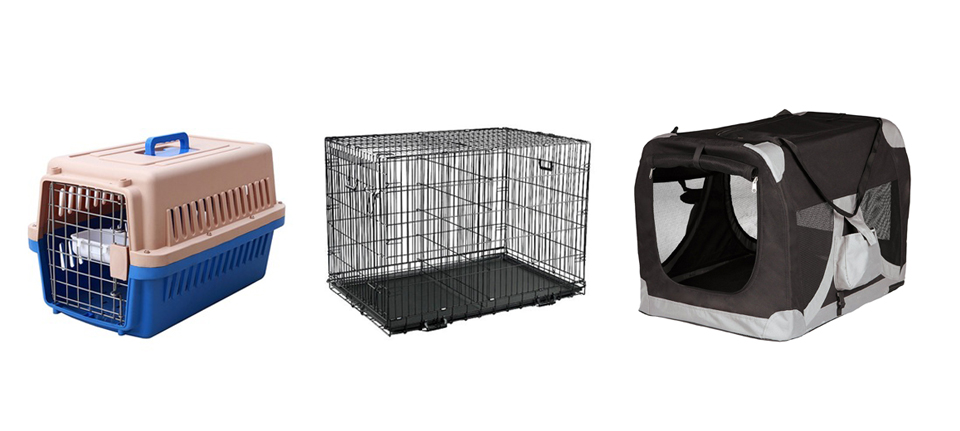
Crates available in the market come in different types and sizes. There are different choices: a plastic pet carrier, a wire cage, or a soft-sided canvas/ nylon crate. Choosing an appropriate crate is a must if you want to effectively crate train your dog.
- Plastic Pet Carrier or Plastic Crate – The plastic pet carrier is usually used by many dog owners. This crate is a great choice for crate training your puppy or dog. You can see this being used the most for air travel because of its lightweight and convenience.
However, this crate has some drawbacks. One, it is enclosed in three sides, which means there’s not much light exposure and it is also slightly difficult to clean.
- Wired Cage or Crate – This type of crate is commonly used by dog lovers. One of its advantages is it allows your dog to look around and see what is going on. A wired cage has an extra panel, which can make it bigger or smaller depending on your dog’s size.
This wired crate is collapsible and easy to use. You can easily clean this type of crate because of its sliding floor tray.
- Soft-sided Canvas or Nylon Crate – Nylon crates are very useful when you are traveling with your dog. This type of crate is lightweight and easy to bring. However, you will surely have a problem if your dog likes to chew or scratch on the sides of the crate because they can possibly escape. This crate is not good for young puppies.
Choosing what type of crate for your dog is important, but it is choosing the correct size that matters most. For one, it should not be too large or too small. The crate should have enough room for your dog to lie down or turn around. They should sleep in comfortably and has enough space to defecate and urinate.
Wire crates can be made to have a specific design in mind, such as a divider, which is suitable for training a growing puppy. The divider can be used to confine your puppy to that small area and move the divider as your puppy grows.
For a more detailed article on how to pick a crate, you can check out our article: How to Pick a Crate for your Shiba Inu
How to introduce the crate to your dog
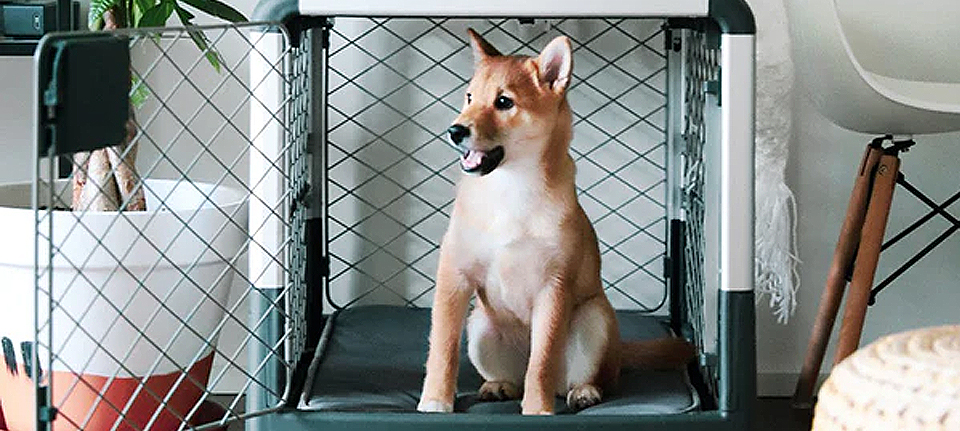
- You need to keep in mind that to successfully crate train your dog, you must keep a positive approach. First, slowly introduce your dog or puppy into the crate and let it establish trust on its own.
- You can put some of your dog’s favorite toys inside the crate to remove his fear or put something soft in the bottom of the crate that can provide comfort to your dog. You can also drop some of your dog’s favorite treats to encourage him to enter the cage.
- If your dog refuses to go inside, it is okay. It is advised to not force your dog to go inside the crate. Instead, allow him to explore. Just continue tossing treats and putting on some of his toys. This process may take a few days.
- Make sure to watch your dog as he is exploring the crate. If he goes in on his own, praise your dog and give some treats. Do this every time he goes inside the crate and wait until he is comfortable with the crate. Keep the crate open and let your dog wander in and out.
- After introducing the crate to your dog and you have observed that they are now comfortable in it, it is now the best time to incorporate the crate with his meals. For starters, start feeding your dog its regular meals near the crate to allow a pleasant association.
- Dogs are naturally den animals, which means they need their own sanctuary that is large enough for them to fit, and to feel secure and comfortable. If crate training is performed correctly, crates can become a paradise for your dog. This behavior will also greatly benefit as a perfectly crate-trained dog can give an ease of mind while you are not at home.
You, as a dog owner, would know when you have successfully crate train your dog as you’ll begin to notice they it will seek out their crates long after housetraining has been accomplished. Other dog owners allow their dogs to have some free run inside the house when they are out because they know that their dogs won’t cause an accident or become destructive.
Here are some tips you must remember when it comes to crate training your dog:
- If you noticed that your dog is now comfortable going in and out of the crate, start your dog to get used to confinement.
- Throw some of his favorite treats, and once he goes inside, closes the door immediately.
- Wait for a few minutes, and if your pet remains quiet, let it out of the crate.
- Slowly increase the amount of time you leave your dog inside the crate while you are at home. Do this regularly until such time your dog is now able to feel comfortable while being confined for several hours or more.
- Once your dog is comfortable with being confined, start getting your dog used to being left alone inside the crate.
- When your dog is quiet and calm inside the crate, leave the room for a few minutes, and then go back in.
- Increase the amount of time until your dog is now comfortable being left alone in the crate for more hours.
Crate Train your Dog: Do’s and Dont’s
One thing that you should never do is to use the crate to punish your dog. Again, the crate serves as a haven, a happy, comfortable, and safe place for your puppy or dog. If you use the crate to punish your dog, it will only cause anxiety, and your dog will become fearful left in it.
Another important thing to remember is to never leave your dog in the crate when he’s barking or whining. Your dog should be completely calm when you let him out. Opening the crate when your dog is whining or barking will led them to think that making noise will let them out.
Finally, never leave your dog inside the crate for longer than they are able to hold its excretion or urination. Puppies can only hold it for three to four hours. Adult dogs who have never experienced house training should also not be left for longer than three to four hours. Older dogs can hold it a little longer.
Dogs should not spend a lot of their time inside the crate without being taken out for exercise, playtime, and cuddling with you.
For more information, you can also check out Simpawtico Dog Training’s video on Crate Training Definitive Guide – Why and How to do it.
A step-by-step crate-training progression for a Shiba
Crate training fails when people skip straight to closing the door and leaving. The dog never learned the crate was good, so the first long stint teaches the opposite. This progression moves in small, winnable steps, and you only advance when the current step is easy and boring for your dog.
- Make the open crate a good place. Leave the door open and toss treats, a favorite chew, or meals inside. Let the dog wander in and out with zero pressure. You want your Shiba deciding the crate is worth visiting before confinement ever enters the picture.
- Feed every meal inside. Move the food bowl to the back of the crate. Eating in there, door open, builds a daily positive routine and gets the dog comfortable spending real time in the space. Nothing scary happens, food just appears there.
- Close the door for seconds. Once the dog is relaxed inside, shut the door for a few seconds while it eats or chews, then open it before it finishes. Slowly stretch the closed time. The goal is for the closing door to mean nothing, because it always opens again while the dog is still calm.
- Add a cue and step away. Pair a word like "crate" with the dog going in, reward it, and start leaving the room for a minute, then five, then more. Vary the times so the dog cannot predict a long absence. Come back before it worries, not after it starts to.
- Build to alone-time and overnight. Once short absences are boring, extend to real departures and nighttime. A crate near your bed at night helps a new dog settle. Keep durations reasonable, since no dog should be crated all day, every day.
- Read whining correctly. Low-level fussing that fades as the dog settles is normal, and letting it out mid-tantrum teaches noise works. Frantic, escalating panic, drooling, or bar-biting is different and means back up several steps or get help. Never wait out true distress.
One dog we placed had been "crate trained" by a previous owner who simply locked it in for nine-hour workdays. It arrived terrified of the crate and would freeze at the door. We threw the timeline out and restarted at step one, feeding every meal inside with the door open, and over a few weeks the dog went from bolting to napping in there voluntarily. The crate itself was never the problem, the rushed introduction was. Choosing the right crate matters too, which we cover in how to pick a crate for your Shiba Inu, and because crate work and alone-time are tightly linked, our guide to Shiba Inu separation anxiety is worth reading alongside this.
How this plays out in real life
Across 250-plus Shibas placed since 2019, the crate successes and failures split cleanly on one thing: pace. Owners who spent the first two weeks making the crate a good place, before ever asking for a long stint, end up with dogs that treat the crate as a bedroom. Owners who needed it to work by day two, usually because of a work schedule, tend to create the exact crate aversion they were trying to avoid. Shibas do not grant the benefit of the doubt. If the crate has ever meant panic, the dog remembers, and rebuilding trust takes far longer than doing it slowly the first time.
The other reliable pattern is confusing housetraining with confinement. A crate helps with potty training because dogs avoid soiling where they sleep, but only if the crate is sized right and the dog is not left past what its bladder can hold. Get those wrong and the crate stops working on both fronts. When a dog genuinely cannot tolerate the crate no matter how carefully it is introduced, that is usually separation anxiety, not stubbornness, and it needs a real plan from a qualified trainer or veterinary behaviorist rather than more hours in the box. Our one-on-one training often starts exactly here, untangling whether a crate problem is a training gap or an anxiety problem, because the fixes are completely different.
Related questions
How long does it take to crate train a Shiba Inu?
Plan on a few weeks of short, daily sessions for a dog to be genuinely comfortable, though some take longer and rushed dogs can take much longer to repair. Puppies often adapt faster than adults with a bad crate history. The pace is set by the dog, not the calendar. Advancing only when each step is easy is what makes it stick.
Is it cruel to crate a Shiba Inu?
Not when the crate is introduced properly and used reasonably. A well-conditioned crate gives a dog a safe den and keeps it out of trouble when unsupervised. It becomes a problem when a dog is confined too long, day after day, or when the crate was forced rather than built up. The tool is fine, the misuse is the issue.
Should I let my Shiba cry it out in the crate?
Distinguish fussing from panic. Mild whining that settles within a few minutes is fine to wait out, since letting a dog out mid-fuss rewards the noise. But genuine panic, escalating screaming, drooling, or trying to break out, should never be waited out, because it deepens the fear. Panic means the introduction moved too fast or something else is going on.
What to read next
Pair this with how to pick a crate for your Shiba Inu and our Shiba Inu potty training guide, since crate work and housetraining move together. If your dog struggles with being alone, read about Shiba Inu separation anxiety, and our one-on-one training can build a plan when the crate is not clicking.
Need help training your Shiba?
Long-term behavior modification and skill training, built for the breed.