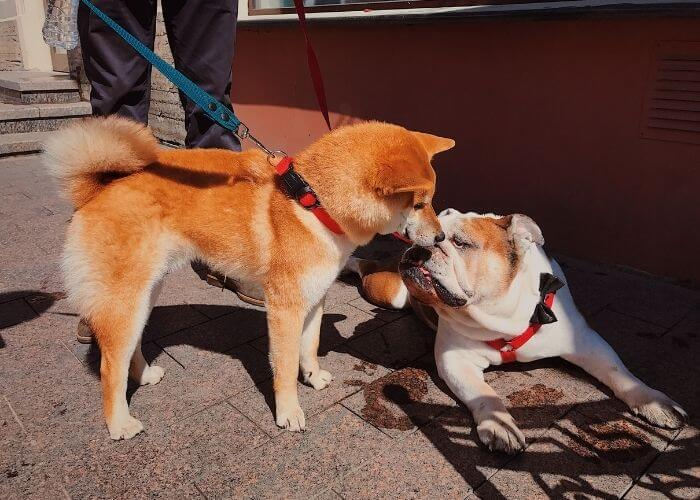
No matter how friendly your Shiba Inu is, remember they are still territorial animals, and introducing a new dog at home can be challenging.
Most fur parents make the mistake of not giving dogs enough time to adjust to each other and simply deciding that two dogs in the house will not work. However, it can sometimes take weeks or up to a month for the old and new dogs to accept each other’s presence.
Introducing two dogs to each other is a process so don’t expect any overnight besties. There is an adjustment period, but once you’ve overcome this hurdle, your old and new dogs will surely enjoy each other’s companionship.
Introduce a Shiba Inu to other dogs slowly and on neutral ground, reading body language at every step rather than forcing contact.
A Shiba is territorial and independent by nature, so the pace of the introduction matters more than the setting. Rushing the first meeting is the single most common reason two dogs fail to settle under one roof. Keep early sessions short and positive, and let each dog opt out when it needs a break. Done patiently, most Shibas learn to share space even if they never become inseparable.
The short version, in four parts:
- Meet on neutral territory where neither dog has claimed the space.
- Keep both dogs leashed and walk them in parallel before any face-to-face contact.
- Watch body language closely and interrupt the moment either dog stiffens.
- Move to offleash time only once both dogs stay loose and relaxed near each other.
How to Introduce Shiba Inu to Other Dogs
How your dogs meet the first time is the most crucial part of the process. You don’t just walk into your home with a new dog in tow, expecting your old pooch to simply accept it. Naturally, it’ll feel as if the newcomer is an intruder. Their guards will be up and their territorial instincts will kick in.
So to make the introduction as smooth sailing as possible, here are the things you need to know.
The dogs’ compatibility
Some dog breeds are more friendly than others so if you have two that are welcoming to new housemates, then the introduction is a bit easier. Aside from temperaments, also take into consideration sizes and ages.
If one dog is bigger than the other, this can cause unintentional injuries. An older dog and a new younger dog might also not be a good match considering younger pooches have tons of energy that senior dogs will not tolerate.
Introduce on a neutral territory
Make sure your Shiba Inu and your new dog’s first meeting goes well by introducing them on neutral territory. This means an area neither dog has ‘claimed’. If possible, the area should be quiet with little to no people or other dogs. This could be the backyard of someone you know or the park during off hours.
If the option above is not possible, a spacious outdoor area that will allow the dogs to roam on leash will also do.
Each dog should be walked separately on a leash. At first, walk the dogs at a good distance where they can see each other but not too close where they are threatened by the other’s presence. If there are not showing any negative behaviors, reward each with treats. Repeat often.
Remember to put away anything that will cause a fight, like dog toys, bones, and beds.
Look at each dog’s body language
Your Shiba’s body language says a lot of its current feelings. And when introducing a new dog, you should pay attention to each of their body languages.
If your Shiba Inu and the new dog is displaying happy body languages, such as wagging tails, no hard stares, and no tense postures, this means they are interested in knowing each other.
And this is a good start and you can begin closing in on their distance.
However, if one or both dogs are showing negative or defensive behavior, such as teeth baring, growling, and hair standing up, then immediately interrupt the eye contact and distract your dog with other things.
If your Shiba is trying to get away from the other dog, don’t send him back. This might mean that he needs a break from the interaction.
Walk them together
After the initial introduction, parallel walk with both dogs. This is better done with another person walking the other dog so you can maintain a good distance, just far enough that they are still aware of each other.
Walk both of them in the same direction. Then, turn back and trade dogs with the other walker. This gives each dog a chance to scent where the other dog has walked.
Urine-sniffing is one of the way dog know information about other dogs so allow each to look into potty spots.
If your Shiba and the other dog are displaying relaxed, social behaviors towards each other, slowly decrease their distance while continuing the parallel walk and try to avoid a direct face-to-face approach.
Let them interact off-leash
If you see that the dogs are now comfortable with each other, go to an enclosed area, take off the leashes, and allow them to interact. Give both dogs time to sniff one another.
After a few minutes, they could still be sniffing each other or might start playing. A dog’s invitation to play is putting its elbows on the ground, its rear end in the air, and its tail wagging.
Still, pay attention and make sure they are peacefully playing, without signs of aggression.
A Step-by-Step Framework for the First Meeting
The introduction goes smoother when you break it into stages and refuse to skip ahead. Here is the sequence we follow with Shibas coming into new homes.
- Prepare the environment first. Remove anything worth guarding before the dogs meet: food bowls, chews, favorite toys, and beds. Resource guarding sparks more first-day tension than genuine dislike does. A neutral, decluttered space lowers the odds that a minor moment escalates.
- Start with parallel walks. Two handlers walk the dogs in the same direction at a distance where both stay calm. You are not aiming for contact yet, only for each dog to register the other as unremarkable. Close the gap only as their body language stays loose.
- Read the body language honestly. Loose tails, soft eyes, and relaxed mouths mean keep going. Hard stares, stiff posture, raised hackles, or a frozen stance mean create distance immediately. A Shiba that turns away is asking for room, not being rude, so let it disengage.
- Trade scents before faces. Swap which dog walks ahead so each can sniff where the other has been, and let them investigate potty spots. Scent tells a dog far more than a nose-to-nose greeting, which many Shibas find confrontational anyway.
- Allow short offleash contact. In a securely enclosed area, drop the leashes and let them sniff for a minute or two, then call them apart. Ending on a calm note beats letting a good session run long and sour.
- Manage the household for weeks, not days. Feed separately, supervise closely, and give each dog its own retreat space. Full acceptance can take a month, and that timeline is normal.
One Shiba we placed after 2019 spent the first ten days ignoring the resident Labrador entirely, then quietly started sleeping in the same room. The owners nearly gave up on day three. Patience, not intervention, closed the gap. For the temperament backdrop that explains why Shibas run cautious with strangers, see our Shiba Inu aggression guide, and for foundational work before any introduction, read how to socialize a Shiba Inu.
What We See Across Hundreds of Shiba Introductions
Since 2019 we have placed more than 250 Shibas, and a large share of those homes already had a resident dog. The pattern is consistent enough to plan around. Shibas rarely fail an introduction because they are aggressive. They fail because the human moved too fast, left a high-value item on the floor, or misread a warning signal as playfulness.
What works: slow openings, separate feeding for the first few weeks, and giving the Shiba a door it can walk through to escape. What does not work: hovering, forcing nose-to-nose greetings, and treating the first tense moment as proof the match is doomed. We have watched pairs that snapped on day one become nap partners by week three once the owners backed off and let the dogs set the pace.
Same-sex pairings, especially two females, deserve extra caution. They can work, but they carry a higher chance of friction, so we slow the timeline further and keep management tighter. Size mismatches matter too. A bouncy young dog and an older Shiba with less patience is a supervision job, not a set-and-forget arrangement.
If you are bringing a second dog into a home with an established Shiba and the early days feel rocky, that is not automatically a failed match. It is usually a pacing problem, and a structured plan with a neutral third party often turns it around. When owners want hands-on help, our 1-on-1 training sessions cover introductions and multi-dog household management directly, and a professional set of eyes catches the signals that are easy to miss when you are emotionally invested in the outcome.
Related Questions
How long does it take for a Shiba to accept another dog?
Plan for weeks, not days. Many Shibas need two to four weeks of managed cohabitation before they relax fully, and some take longer. The dogs do not have to become best friends. Calm, peaceful coexistence with separate spaces is a completely successful outcome and often the realistic ceiling with an independent breed like this one.
Can I introduce a Shiba puppy to an older resident dog?
Yes, but watch the energy gap. A puppy's constant pestering can wear down an older dog that wants quiet. Give the senior dog puppy-free zones and enforced rest, and never leave the two alone together until you are certain the older dog is comfortable. Short, supervised sessions build the relationship faster than long unsupervised ones.
What if my Shiba growls at the new dog?
A growl is information, not a verdict. It means your Shiba feels crowded and wants space, which is useful to know. Increase distance, lower the intensity, and never punish the growl itself, because a dog that learns growling gets punished may skip the warning next time. If growling escalates or you see repeated stiff, frozen postures, consult a qualified trainer before continuing.
What to Read Next
If you are weighing whether a multi-dog household suits this breed at all, start with is a Shiba Inu right for me. To build the social foundation that makes introductions easier, read how to socialize a Shiba Inu and introducing your Shiba to cats. And if you want a supervised setting where dogs build familiarity over time, our boarding and daycare program is built for exactly that.
Looking to adopt or rehome a Shiba?
Rescue-first rehoming with vetted families, 1-year health guarantee, lifetime support.