
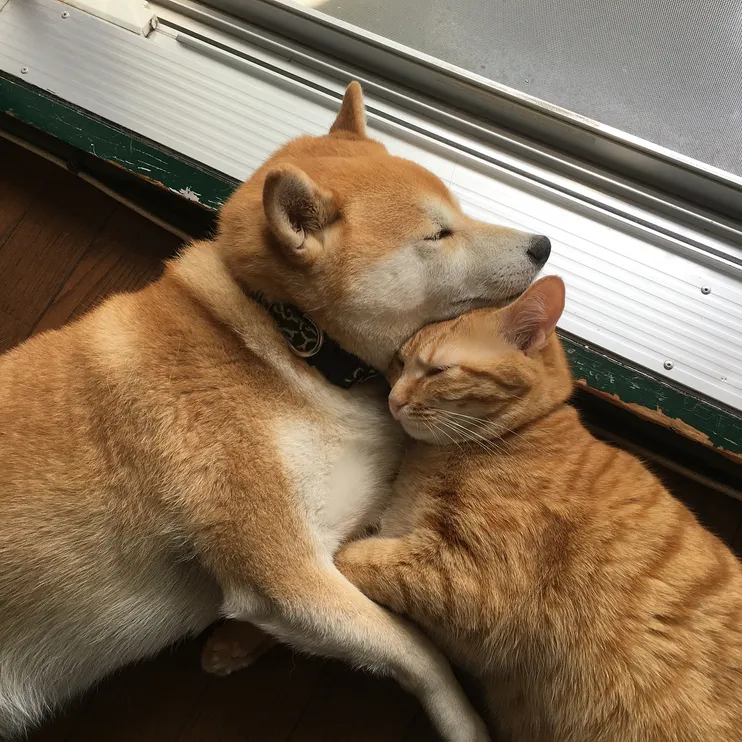
Most individuals think that cats and dogs will never get along. This is a myth! In fact, there are certain dog breeds that are naturally good with cats and for canines that aren’t, proper socialization makes it so you can have both cats and dogs at home.
If you have a Shiba Inu, you will know they make wonderful family dogs. But, you also know that they have a dominant personality that makes sharing the space a bit challenging.
A Shiba Inu can absolutely live with a cat, but it is not automatic, and success depends on the individual dog's prey drive, the cat's temperament, and a slow, managed introduction rather than a hopeful free-for-all. Shibas were bred to hunt small animals, so a darting cat can trigger a chase instinct that has nothing to do with meanness and everything to do with wiring. The households that work are the ones that separate first, then introduce by scent, then by sight, then under supervision, over weeks, and that always give the cat an escape route and high ground. Some Shibas settle into gentle housemates, and a few never should share a home with a cat. Knowing which you have takes honest observation, not wishful thinking.
The short version, in four parts:
- Prey drive is instinct, not meanness, so respect it instead of punishing it.
- Introduce in stages (scent, sight, supervised) over weeks, never all at once.
- Give the cat vertical space and a dog-free escape at all times.
- Some pairings work beautifully and some never should, so watch honestly and do not force it.
Do Shiba Inu and cats get along?
There’s no definite answer if a Shiba Inu and a cat get along. It still entirely depends on both of their personalities. But based on Shiba’s proud temperament, friendship won’t happen overnight.
Shiba Inus were originally bred to be hunting dogs, and even though it’s been modern times and they are no longer trained to hunt, the instinct stayed.
Naturally, they have a high prey drive which means they are very attracted to chasing small and fast-moving animals. And though cats are not, generally, small and fast-moving, a roaming one at home can still trigger this hunting impulse.
Shibas are also famously known to be stubborn and assertive. These personalities will most likely lead to your Shiba Inu overpowering your cat in the first few weeks they are together.
It takes two to tango, so you also need to take note of your cat’s personality as well. A more relaxed cat that’s been around other pets might warm up faster to your dog than a dominant cat.
How to introduce Shiba Inu to cats
Slowly introduce your Shiba Inu to your cat and keep watch of their interaction the first time. Give them time together so they’ll be able to build a bond. It is also best to start while they are still young.
Let them smell
Sniffing is an animal’s way of gathering information about its surroundings. So before having them personally meet, allow your Shiba and cat to investigate first.
Give your cat something your Shiba uses, like a favorite toy, and vice versa. Allow your Shiba to smell your cat’s favorite spot or pillow.
Prepare a meeting space
Their first meeting can be overwhelming for both of them, especially if you’ve observed contrasting personalities.
So prepare an open space where there are areas your cat can reach but your Shiba can’t. This could be a table, a cabinet, under the couch, or just a place your cat can escape to.
Later on, even though your cat and Shiba Inu have been acquainted, make sure your home has a dog-free zone for your cat to hide and hang out.
Keep your Shiba on a leash
For their first introduction, you don’t want to leave these two alone. You need to keep watch of this first interaction, especially noting your Shiba’s body language or if they are displaying negative behavior.
This is why it is safer to keep your Shiba on a leash first as they socialize and get to know each.
Allow your cat to run
Seeing your Shiba for the first might stress your cat out, and just like humans, stress is also bad for your pets. So if your cat wants to run away during their first meeting, let them. Allow them to breathe and walk over again on their own.
Closely monitor
In their first introduction, your focus should be on your cat and Shiba Inu. Rid off distractions like your phone and put all attention to your pets and their body language.
Make sure your Shiba is on a leash and watch if they are starting to get worked up. If they are, command them to sit and calm them down.
Repeat daily
Slowly, steady, and be consistent. Allow your cat and Shiba Inu to meet daily so they’ll get used to each other’s presence and until you can start leaving them unsupervised. Reward with treats, both cat and dog, if they are good and getting along well.
After a few weeks, you might have yourself a cat and dog best friend pair.
A stage-by-stage plan for introducing a Shiba to a cat
The goal is to let both animals decide the relationship is safe before they ever share a room unsupervised. Move through these stages in order, and only advance when both are relaxed.
- Set up before they meet. Give the cat its own territory the dog cannot reach, with the litter box, food, water, and tall perches all in dog-free zones. Cats feel safe when they have height and exits. Baby gates, a cracked door with a hook, or cat shelves buy you the separation the early stages depend on.
- Swap scents. Before any face-to-face contact, trade scents. Rub a cloth on the cat and leave it near the dog's bed, and the reverse. Feed both animals on opposite sides of a closed door so each associates the other's smell with something good. This is slow and boring, which is exactly why it works.
- Introduce through a barrier. Once both are calm with the scent, let them see each other through a gate or a cracked door. Keep sessions short and end them while everyone is still relaxed. If the Shiba locks on, fixates, and cannot look away, you are moving too fast; add distance and time.
- Supervised, leashed meetings. The first open-room meetings happen with the Shiba on a leash and the cat free to leave. Reward calm attention on you, not on the cat. Never trap the cat in a corner, and never let the dog rehearse a chase. Many short, boring successes beat one exciting failure.
- Read the body language. Curiosity is a soft body, a loose tail, and the ability to disengage. Prey drive is a hard stare, a still crouch, and a dog that will not break focus. On the cat's side, flattened ears, a puffed tail, or hiding means back off. Learn these signals, because they tell you the truth faster than any timeline.
- When it is not working. If the drive stays high after weeks of honest effort, the answer might be permanent management (separate zones, never unsupervised) rather than full integration. That is not a failure, it is a fair call. A minority of Shibas should not live loose with a cat, and forcing it is unfair to the animal with less power in the house.
A composite from the kind of case we counsel through: a family adopts a Shiba into a home with a confident older cat. The first week is all closed doors and scent cloths, the second is gated glimpses, and by week four the two are napping in the same room, the dog on the floor, the cat ruling the bookshelf. It worked because nobody rushed and the cat always had the high ground. Because prey drive sits at the center of this, our honest breakdown of whether a Shiba Inu is right for you is worth reading first, and the same slow-introduction logic applies to dogs in introducing your Shiba to other dogs.
What we tell adopters who already have a cat
Across 250+ Shibas placed since 2019, a home with a resident cat is one of the first things we factor into a match. Prey drive varies a lot dog to dog, and the honest truth is that some of our Shibas would be wonderful with cats and some would not, so we try hard not to place the wrong dog into a cat household.
What has worked: matching temperament to the home, then setting expectations hard. We tell cat families to plan for a multi-week introduction, to keep the animals separated when nobody is home for a long while, and to give the cat a fortress the dog cannot breach. Families who treat it as a project rather than a hope tend to land well.
What has not worked: assuming a calm meet-and-greet means a safe household. A Shiba can be polite for ten supervised minutes and still chase given an open door and a fleeing cat. That is why, when a match involves a cat or other small pets, we lean on a proper read of the dog's prey drive before placement. Our Behavioral Evaluation is built for exactly this kind of question, so a family knows what they are working with before the dog comes home.
Related questions
Can a Shiba Inu ever be trusted alone with a cat?
Some can, over time, and some never should be. It depends entirely on the individual Shiba's prey drive and the history between the two animals. Even a Shiba who coexists calmly under supervision may not be safe unsupervised for months, if ever. The safe default is to separate them when nobody is home until you have a long, consistent track record of calm behavior, and to accept that a few dogs simply need permanent management.
How long does it take to introduce a Shiba to a cat?
Plan on weeks, not days. A typical introduction moves through scent swapping, barrier meetings, and supervised time together, and each stage lasts as long as both animals stay relaxed. Rushing is the most common mistake, because one bad chase can set the whole process back. Let the animals, not the calendar, set the pace, and be ready for some pairings to take a month or more.
What if my Shiba keeps chasing the cat?
Go back a stage and add more management: barriers, leashes indoors, and vertical escape routes for the cat. Chasing is self-rewarding, so every successful chase makes the next one more likely, which is why prevention beats correction. If the drive stays high despite consistent work, talk to a trainer or behavior professional, and be honest with yourself about whether this particular pairing is fair to the cat.
What to read next
Since prey drive shapes so much of Shiba life, start with whether a Shiba Inu is right for you. The same staged approach helps with introducing your Shiba to other dogs and introducing your Shiba to children. And if you want a clear read on a specific dog's prey drive before adding it to a home with a cat, our Behavioral Evaluation gives you that.
Looking to adopt or rehome a Shiba?
Rescue-first rehoming with vetted families, 1-year health guarantee, lifetime support.