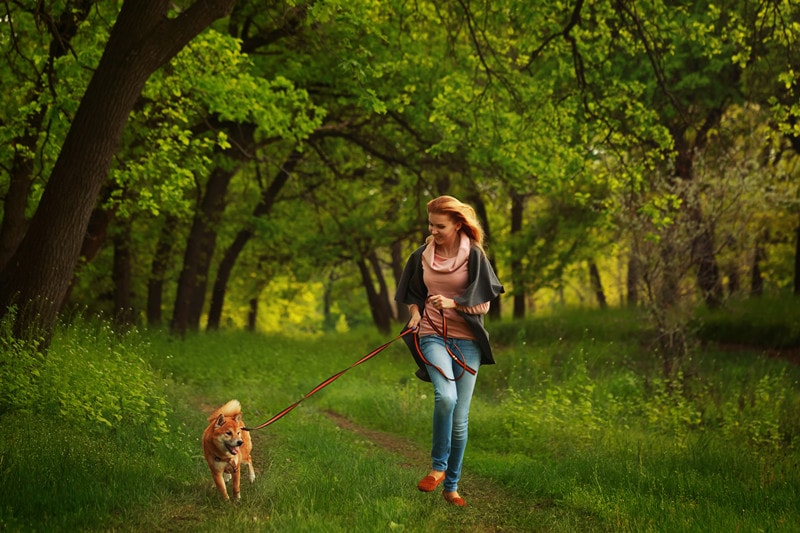
Athletic fur parents would want to involve their pets in their daily activities. And this is good because not only does this keep you in shape, but also helps maintain your dog’s weight and health. One of the most enjoyable exercises you can introduce to your Shiba Inu is running.
Running is physically and mentally beneficial for your dogs. Not only does it help with weight loss, but the different sight, sound, and smell stimulate their brain. It also reduces anxiety and boredom.
A healthy, fully grown Shiba Inu can make an excellent running partner. The breed is athletic, energetic, and built for distance, so once conditioned, many Shibas love a steady run. But that "once conditioned" carries real conditions. Puppies should not run distance because their growth plates are still open, heat and hot pavement are genuine dangers for a double-coated dog, and a Shiba that has not learned loose-leash walking is unsafe to run with at speed. Get a vet's clearance, build the walking foundation first, and increase distance gradually, and you have a running buddy for years.
The short version, in four parts:
- Wait for maturity. Distance running is for grown Shibas with closed growth plates, not puppies.
- Walking comes first. A reliable loose-leash walk is the prerequisite for running safely.
- Respect the weather. Run in cool hours, test the pavement, and skip the heat of the day.
- Build slowly. Condition endurance over weeks, and let your individual dog's interest guide you.
How to Run with your Shiba Inu
While it seems like dogs naturally enjoy running, keep in mind that running with the intention to play is different than a structured running routine.
With playing, it is usually spontaneous and in irregular patterns, while a structured one is running in a straight line and for an extended period of time.
So if you want your Shiba Inu to be the perfect running buddy, here are things you need to know.
Check if your dog is the right breed and age
The first thing to tick off is knowing if your dog is suitable for running.
Dogs with short muzzles, like the Bulldogs or Pug, should only sprint for short distances or avoid intense running if possible, while breeds like the Husky, Dalmatians, Golden Retrievers and Collies are amazing running companions.
The Shiba Inu is a good breed for long-distance running. They are full of energy and are extremely athletic. As long as they are healthy, trained, and at the right age, running longer distances should not be a problem.
The second thing to consider is the dog’s age and health.
Puppies should not be involved in long-distance running as their bones are still developing, making them prone to injuries. For most breeds, dog should be around 1.5 years old for it to start intensive running.
The same goes for dogs with joint issues. If you are looking at running exercises as a way to shed some weight off your dog, it’s worth going to the vet for a consultation. There are gentler ways for your dog to lose weight that should be okay for their joint concerns.
Take note that even though your dog belongs to the running breed, it still has its own personality and some might not even like running at all.
Look out for the weather
Before gearing up for a run with your Shiba Inu, always check the weather.
Heat can be dangerous for dogs, especially those with thicker coats, and can result in heat exhaustion and heat stroke. One tip that dog owners used is to put the back of their hands on the ground for five to seven seconds and if it’s too hot for you, then it’s too hot for your dog’s paws as well.
During the summer, it is recommended to run early morning or in the evenings.
In colder weather, it is also best to not stay out for a long time. It is possible for them to dehydrate in cold weather. Another possibility is also dogs losing their balance and ice injuries.
You have more time during the fall and spring seasons, but veterinarians say you should be careful of the terrain your dog is running on. Concrete and asphalt are harder on the dogs’ joints and can damage their paws.
Start slow
Just because your dog is the right breed, at the right age, and is healthy, doesn’t mean they are automatically qualified for a 10km run.
Dogs need to build up their endurance so always start by doing an easy and short run. If you see your Shiba starting to get comfortable, gradually increase the distance. Look for a location or a trail that you both would like and incorporate jogging and walking into the run.
Master walking before running
Running, as simple as it seems, still requires training.
Before bringing your Shiba out for a run, make sure he has mastered loose-leash walking. This means that your dog is walking by your side without pulling on its leash.
A dog that hasn’t mastered loose-leash walking and is straight introduced to running is dangerous, especially at faster speeds. So always train them with walking first before going on a run.
Also, one of the basic things to teach your dog when running is to keep them on one side. Not in front of you and not weaving from side to side as they can trip you or tangle your legs with their leash.
Start with a walking pace and keep rewards and positive reinforcement in mind. If you want them on your left, offer treats on your left side. Once your Shiba is fully trained, then you can start with a hands-free dog leash walk or run.
A pre-run checklist for Shiba owners
Before your Shiba becomes a running partner, work through these five in order. Skipping ahead is where injuries and bad habits start.
- Age and vet clearance. Wait until the growth plates have closed, usually somewhere around a year and a half, before any distance running, and confirm the timing with your vet. Ask specifically about joints and heart, especially if running is meant to help an overweight dog, since gentler options may be safer.
- Loose-leash foundation. A Shiba must walk reliably at your side without pulling before you add speed. A dog that lunges or weaves at a walk becomes a tripping and injury hazard at a run. Master the walk first, on one consistent side.
- Weather and terrain. Heat is dangerous for a double-coated dog, so run in the early morning or evening and use the seven-second pavement hand test. Favor dirt trails and grass over concrete and asphalt, which are hard on joints and pads.
- Gradual conditioning. Endurance is built over weeks, not in one ambitious outing. Start with short run-walk intervals, increase distance only as the dog stays comfortable, and watch for lagging or soreness as the signal to ease off.
- Gear and safety. Use a well-fitted harness rather than a collar, carry water for both of you, keep ID and a secure leash on at all times, and consider a hands-free leash only once the dog is fully trained. A Shiba's prey drive means never trust an off-leash run near roads or wildlife.
One Shiba we boarded came from an owner who had jumped straight to three-mile road runs with a dog that pulled hard on-leash. The dog was strong enough to do it, but it yanked, tripped the owner twice, and came back with worn pads from the pavement. Backing all the way up to loose-leash walking on grass, then rebuilding distance slowly, turned a stressful drag into an actual partnership. The fitness was never the missing piece. The foundation was.
Whether your Shiba even enjoys structured running comes down to the individual dog and the breed's temperament, which is worth understanding before you commit. For the honest read, see whether a Shiba Inu is right for you. And because running is easy to overdo with a high-drive dog, pair this with how much exercise is too much.
What we have seen
Across 250-plus Shibas since 2019, the Shibas that turn into great running partners almost always had the walking foundation first. The failures were not fitness failures. They were dogs asked to run before they could walk politely, or dogs pushed onto hot pavement in the middle of a summer day.
What worked: waiting for physical maturity, building loose-leash walking to a reliable standard, conditioning distance slowly, and running trails in cool hours. What did not work: distance running with a puppy, road running with a puller, and assuming that because the Shiba is athletic it must want to run. Plenty of perfectly fit Shibas simply prefer sniff walks, and that is a valid preference to respect.
Two cautions we hold to. Get veterinary clearance before starting a running routine, particularly for a young dog whose growth plates may still be open or an older dog with joint wear. And build the leash skills that make running safe before you ever pick up the pace. That loose-leash foundation is exactly what we work on in our 1-on-1 training sessions.
Common followup questions
At what age can a Shiba start running?
Not until the growth plates have closed, which is usually around a year and a half, though it varies by dog. Running a puppy on hard surfaces or for distance can cause lasting joint damage. Free play and short walks are fine early on, but save structured running for a physically mature Shiba, and confirm the timing with your veterinarian first.
How far can a Shiba run?
A healthy, well-conditioned adult Shiba can handle surprisingly long distances, because the breed is athletic and built for stamina. But distance has to be built gradually over weeks, not attempted all at once. Watch for lagging, heavy panting, or soreness afterward, which mean you went too far. Let the dog's comfort, not a target number, set the limit.
Do all Shibas enjoy running?
No. Being athletic does not mean every Shiba wants a structured run, and the breed's independent streak means some flatly prefer to sniff and wander. Forcing a reluctant dog to run rarely goes well. If your Shiba drags its feet or seems stressed, honor that and find activity it actually enjoys, whether that is hiking, scent work, or play.
What to read next
If you are still weighing the breed, our honest guide on whether a Shiba Inu is right for you covers energy and temperament. For pacing activity safely, read how much exercise is too much, and for the leash skills running depends on, loose-leash walking your Shiba Inu. To build that foundation with help, see our 1-on-1 training.
Looking to adopt or rehome a Shiba?
Rescue-first rehoming with vetted families, 1-year health guarantee, lifetime support.