
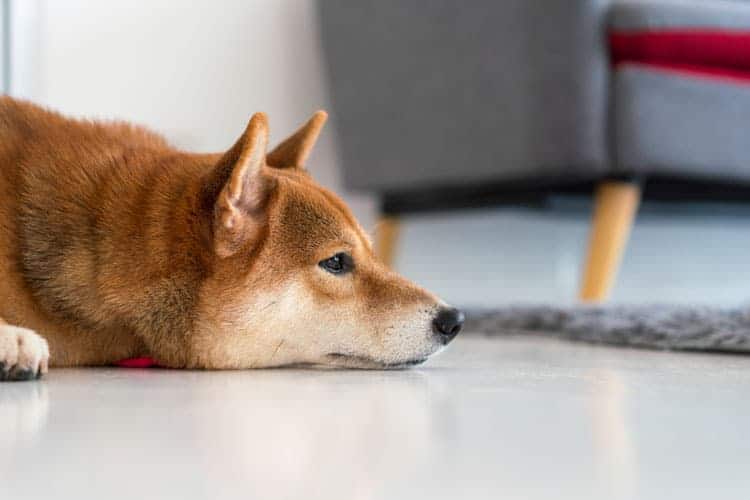
Shiba Inus can develop anxiety issues and fear, which can eventually lead to biting, scratching, or clawing. If you love your dog, it’s easy to feel anxious about your Shiba Inu’s anxiety.
Fortunately, there are many ways to help your Shibi Inu’s anxiety. But first, you need to know the symptoms.
You deal with a Shiba's anxiety by finding the specific trigger, building a predictable routine around it, and slowly changing how your dog feels about that trigger through desensitization and reward, never by forcing him to face it. Anxiety in Shibas usually traces to one of a few sources: being left alone, loud noises, unfamiliar people or places, or handling and confinement. The fix depends entirely on which one you are dealing with. Flooding an anxious Shiba (making him endure the scary thing until he gives up) makes things worse. Patience, structure, and small wins make things better. Severe or worsening anxiety is a medical and behavioral issue worth professional help, not something to push through alone.
The short version, in four parts:
- Pin down the exact trigger before you try to fix anything.
- Build a predictable daily routine so the dog can relax.
- Desensitize slowly and reward calm. Never flood or force it.
- Rule out pain or illness, and get help early for severe cases.
Symptoms of Shiba Inu Anxiety
The common symptoms of anxiety amongst Shiba Inu are:
- Chewing
- Urination
- Defecation
- Pacing
- Trembling
It is also important to determine whether your dog is experiencing a severe case of anxiety. It can be challenging to tell if your Shiba Inu has genuine anxiety or is just feeling disobedient.
A few ways to know if the dog is indeed feeling anxious is if they are panting, whining, and pacing.
Types of Dog Anxiety
A Shiba Inu can also experience different types of anxiety.
Separation Anxiety
Being kenneled in the past, being left alone for the first time, a traumatic event, or a sudden change in the family, can be reasons why a dog develops separation anxiety.
Common symptoms of separation anxiety are urinating, chewing, barking, and defecating when they are alone.
Social Anxiety
Shiba Inus are social dogs. That’s why your Shiba Inu needs to socialize for the first 16 months. This is when the Shiba Inu puppies learn about fear and develop their confidence. It is also important for Shiba Inu puppies to be with their mother for at least 8 months after birth. This helps prevent social anxiety as well as nutrition problems.
Noise Anxiety
Some dogs can be very sensitive to noise. Fireworks, thunder, and any loud noises can be sources of anxiety for your dog. If they experience noise anxiety, they will hide or flee.
How to treat your Shiba Inu’s anxiety issues
Now that you are aware of the types of anxiety that your Shiba Inu can develop, you must find the appropriate way to deal with these.
This means that you must remain calm and relaxed so your dog will not feel any sign of stress. However, treating your dog’s anxiety is not an overnight fix.
Therapies and exercising can help but it all boils down to finding and using the right treatment that will bring the best results.
Behavior Modification
Changing or modifying a pet’s behavior can be very challenging and the dog owner must focus on things like desensitization and counter-conditioning.
A prime example of this would be if your dog is afraid of a thunderstorm. You might want to encourage your dog to do something fun or positive every time it happens. You are conditioning your dog to associate the things it is afraid of with something positive.
Desensitization
Desensitization must be approached with extra care. If you don’t, you might be bringing your dog more trauma and anxiety.
The way this therapy works is to expose your dog to its subject of anxiety but in small doses and encouraging it to bring new and positive reactions that will help him move on from the issue. In terms of separation anxiety, you can start by leaving your dog in a short amount of time and then increasing the amount over time.
Observe the way your dog responds to triggers and try different actions.
Medications
If your dog is experiencing severe anxiety, medication can be a solution. However, don’t use over-the-counter medications without consulting or prescription from your veterinarian. It is also advised to use behavior modification and other methods, alongside medication.
Conclusion
All dogs have the potential to develop anxiety. Unfortunately, there’s no general solution to this, but the first thing that you must do is to get educated on your dog’s anxiety, its triggers, and the possible solutions. It is also important to not add stress to your dog by remaining calm and relaxed.
The four common anxiety triggers in Shibas
Anxiety is not one thing. Treating it well starts with naming which of these four triggers you are actually looking at, because the plan for each is different.
- Separation. Some Shibas struggle when left alone, pacing, vocalizing, or destroying things near exits. This is its own large topic with its own protocol. For the deeper read, see our Shiba Inu separation anxiety guide, which covers gradual departures, safe confinement, and when medication is warranted. Do not confuse boredom destruction with true separation distress, they look similar but need different fixes.
- Noise sensitivity. Fireworks, thunder, and sudden household bangs set off many Shibas, who then bolt, hide, or shake. The core tools are a safe den, sound masking, and slow desensitization done well before the scary season. This is common and very manageable with preparation.
- Novelty and social fear. A Shiba who missed early socialization can find new people, dogs, and places genuinely frightening. Forcing greetings backfires. Distance, patience, and rewarding calm observation from a comfortable range is the path here.
- Handling and confinement. Nail trims, grooming, vet handling, and being crated can all trigger anxiety, especially in a dog that was handled roughly in the past. Cooperative-care training, where the dog is taught to opt in for treats, turns these from battles into routines.
Consider a rescue Shiba we worked with who "had anxiety" according to his owner. Digging into it, the panic only showed up during nail trims and vet visits, everything else was fine. It was not generalized anxiety at all, it was a handling problem from rough treatment before his rehoming. Cooperative-care work with a lick mat and slow desensitization resolved most of it. Naming the trigger correctly saved months of treating the wrong thing. For fear rooted in a rough past, how to gain the trust of your rescue Shiba Inu pairs well with this.
How this plays out in practice
Since 2019 we have placed more than 250 Shibas, and anxiety is one of the more misread issues we deal with. The most common mistake owners make is comforting the panic in a way that accidentally reinforces it, or worse, forcing the dog to confront the trigger head-on to "get over it." Flooding a frightened Shiba almost always makes the fear deeper, not shallower.
What consistently works is the unglamorous stuff: a predictable daily rhythm, a safe space the dog can retreat to, real physical and mental exercise, and slow, rewarded exposure at a distance the dog can handle. Shibas are sensitive and they read your energy, so an owner who stays calm and matter-of-fact gives the dog something steady to borrow from. Owners who get visibly anxious about their dog's anxiety tend to feed the loop.
The other pattern worth naming: anxiety that appears suddenly in an adult Shiba, or that keeps getting worse despite good management, deserves a vet visit before anything else. Pain, thyroid issues, and other medical problems show up as behavior changes, and no amount of training fixes a dog that hurts. For anything beyond mild, situational nerves, a structured evaluation is the fastest route to a real plan. Our behavioral evaluation exists for exactly this, to sort out what is driving the anxiety and what to actually do about it, and severe cases belong with a veterinary behaviorist (DACVB) or a certified applied animal behaviorist.
Common followup questions
Can a Shiba's anxiety be cured?
Mild, situational anxiety often resolves fully with routine and desensitization. Deeper anxiety is usually managed rather than cured, meaning the dog learns to cope and the triggers lose their power, but you stay mindful of them. The goal is a dog that can function calmly, not a dog with zero nerves. Most Shibas get meaningfully better with the right plan.
Do calming aids and supplements help anxious Shibas?
Some dogs benefit from calming supplements, pheromone diffusers, or pressure wraps, usually as one part of a plan rather than a standalone fix. They tend to help mild cases and take the edge off bigger ones. For moderate to severe anxiety, talk to your vet, who can weigh prescription options. Tools support training, they do not replace it.
Is my Shiba anxious or just bored?
They can look alike, but boredom eases with more exercise and enrichment, while true anxiety does not, and often comes with panic signals like trembling, drooling, or trying to escape. If a hard walk and a puzzle feeder settle your dog, it was likely boredom. If the distress persists regardless, treat it as anxiety and get a professional read.
What to read next
If the anxiety centers on being left alone, our Shiba Inu separation anxiety guide is the deeper resource, and for noise specifically, keeping your Shiba calm during fireworks is a practical companion. Fear from a rough past is covered in how to gain the trust of your rescue Shiba Inu, and when you want a professional read on what is driving it, book a behavioral evaluation.
Need in-home boarding for your Shiba?
Small groups, five walks a day, never a kennel. Daycare and vet transport included.