You bond with a Shiba Inu by earning trust, not demanding affection: stay consistent, respect the breed's independence, and make good things (food, play, freedom) flow through you. Shibas are not needy velcro dogs, and a bond with one looks different from a bond with a Labrador. It is quieter, more mutual, and built on the dog choosing to cooperate rather than being made to. Push too hard for closeness and a Shiba pulls away. Become the reliable source of everything good in his day and he comes to you on his own terms, which is worth far more with this breed.
The short version, in four parts:
- Respect the independence. A Shiba bond is a partnership, not ownership.
- Be consistent. Same rules, same cues, same calm energy every day.
- Run the good stuff through you: meals, play, walks, freedom.
- Never force affection or handling. Let the dog opt in.
Keep In Mind Before You Start
To build a strong bonding with your Shiba Inu, you have to practice respect – respect him for the dog he is.
When you understand a little bit more about the Shiba’s temperament, you can build a stronger and longer lasting bond. Because the Shiba is independent and strong-willed, you have to be gentle yet firm in your communication. He is also highly sensitive – something to keep in mind when issuing dog commands.
Don’t Worry – Stay Calm
Calmness and consistency during bonding and dog obedience training will garner your dog’s ongoing loyalty. For example, when giving dog commands, you need to do so softly but with authority. If you remain calm, so will your Shiba Inu. You also have to stay consistent when communicating with your companion dog.
For instance, you don’t want to lavish your dog with affection one day and yell at him the next for having muddied up the couch with his paws. If you don’t want this to happen, you need to teach your Shiba not to jump up on the furniture. Show him that you are pleased when he rests on the ground level. If you want to keep things positive, you have to remember that you are the alpha dog – you are in control.
Therefore, to bond with your companion dog, you should not punish him for not obeying your dog commands. This is especially true of a Shiba, who feels wounded when treated this way.
Why should you blame him for not understanding? After all, he was not born with the ability to interpret the human language. It is up to you to show him what you mean by the dog commands you give. Fairness is an important component in cementing the Shiba and human bond.
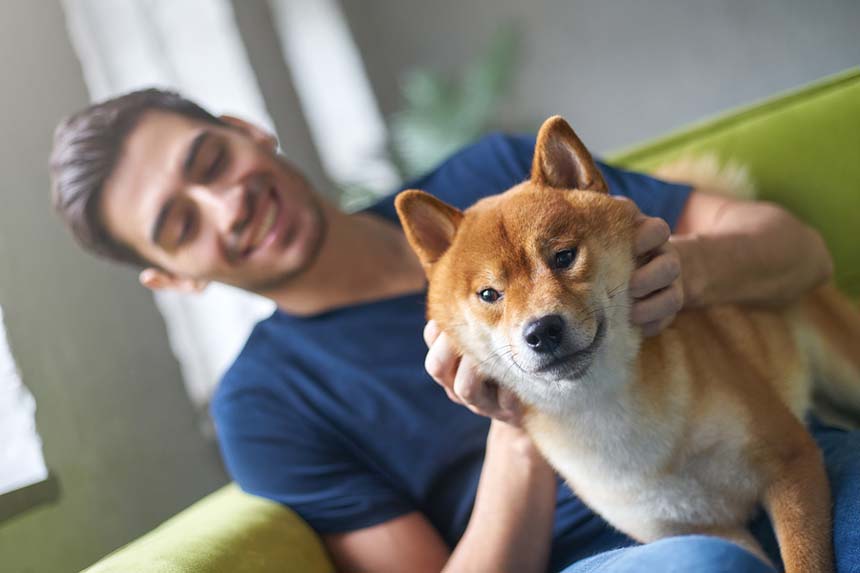
Learning What It takes to Communicate with Your Shiba
When we practice calmness, consistency, and fairness, our companion dog will feel secure, knowing what we expect from him and what he can expect from us. If you show any frustration or anger, you will only stress and confuse your Shiba – something that can easily break the human and companion dog bond.
Redirect Your Fear – Focus on Being Confident
Because Shiba Inus are so strong-willed and stubborn, it does not help the dog owner to show any type of trepidation. Dogs can easily sense fear in humans, especially the sensitive Shiba Inu.
When he picks up this feeling in his owner, any established bond can break. Fear denotes a lack of trust and confidence – in our companion dog and in ourselves. Therefore, you cannot build trust, or bonding with your Shiba, by being timid or scared.
To build a strong and healthy bonding, you need to establish verbal dog commands, including hand gestures, with your companion dog that, after a while, he will easily recognize. You also need to set up rules that can be enforced on an ongoing and consistent basis. Provide a regular routine for your dog for feeding, exercise, and dog obedience training.
Communicating with Your Dog
While establishing a set of rules does not automatically build strong owner-dog relationships, it will define the owner-and-dog relationship roles.
Your dog commands or rules will not do you much good if you try to enforce rules out of fear or anger. Again, you need to exert a soft but authoritative approach and do so consistently and fairly.
For example, if your dog does not obey one of your dog commands, that is not the time to become angry. You have to ask yourself why he is ignoring you or why it is not working.
Again, you cannot blame your companion dog for being himself. In this case, you will just have to wait until your Shiba is ready to participate. If you want to develop a bond with a Shiba Inu, you also have to learn patience.
What to Ask Yourself
To further develop a bond with your Shiba Inu, you need to answer the following questions:
- What do I want to accomplish by strengthening by owner-dog bonding?
- How can I communicate effectively while considering my dog’s sensitive nature?
- How can I keep communications consistent and fair?
- What are the best methods to use for dog obedience training?
- How can I better understand my dog’s care needs?
By answering the above questions, you can outline a dog obedience training plan that will develop your owner-dog bond and make dog ownership both a challenge and more rewarding.
Do You Have What It Takes to Create a Good Bonding?
Even the smartest dog can be hard to train if you don’t calmly communicate. Make all the following characteristics part of your own behaviour in creating a strong bonding with your Shiba Inu – calmness, fairness, consistency, understanding, firmness, gentleness, and confidence.
Also, all those bad dog behaviors, such as chewing, jumping, or chasing, can be redirected more positively when we use the right dog obedience training methods. For instance, set time aside for game activities that feature controlled chasing or running, such as fetch.
Buy safe chew toys to distract your Shiba from chewing on things, such as furniture legs, fabrics, or shoes. It also helps to make your dog work for food treats by providing it with interactive toys that hold food inside. In turn, he has to figure out how to get the treat.

Making Owner-Dog Communications Work
What are some examples of every-day communication and bond building?
For example,
- Go to an area that doesn’t have many people and walk your Shiba on a loose leash so he can use up excess energy.
- Hand-feed your pup kibble treats during dog obedience training to further establish trust.
By taking an ongoing interest in your Shiba’s demeanor and personality, you can find the ideal forms of communication. Good things take time, and a good bond does not happen overnight. That is what you need to keep in mind when communicating with your companion dog.
When you make dog obedience training a priority as well as how you communicate, you will realize dog training success and form an owner-Shiba bond that will leave both of you happy for life.
The five pillars of a Shiba bond
A Shiba bond is built, not switched on, and it rests on five things done consistently over weeks and months. Miss one and the relationship stays shallow. Cover all five and even an aloof Shiba warms up on his own schedule.
- Respect for independence. Shibas were bred to work alone and think for themselves, and they read forced closeness as pressure. Let your dog approach you rather than constantly reaching for him. Counterintuitively, the owners who give a Shiba space often get the most affection back.
- Consistency. Same cues, same house rules, same calm tone every day. A Shiba who can predict you feels safe with you, and safety is the foundation the whole bond sits on. Mixed signals, affection one day and frustration the next, quietly erode trust.
- Food as currency. Hand-feeding meals, using kibble in training, and being the source of the best treats moves you to the center of your dog's world fast. This is not bribery, it is association. Your dog learns that good things come through you.
- Shared activity. Sniffing walks, gentle games of fetch or tug, and low-key adventures build a bond through doing, not just being. A Shiba who works and explores alongside you starts to see you as a teammate rather than a manager.
- Calm handling. How you touch, groom, leash, and pick up your Shiba either builds trust or drains it. Go slow, pair handling with rewards, and never wrestle a resistant dog into compliance. A Shiba that trusts your hands is a Shiba that stays close.
Consider an adopter who came to us frustrated that her rescue Shiba would not cuddle. She had been scooping him up for hugs several times a day, and he had started hiding when she approached. We had her stop the forced contact entirely and instead hand-feed every meal and sit on the floor doing nothing. Within a few weeks the dog was climbing into her lap on his own. If you are still learning what makes the breed tick, our honest read on whether a Shiba Inu is right for you lays out the temperament, and for adopted dogs specifically, how to gain the trust of your rescue Shiba Inu goes deeper.
What we have seen across 250+ placements
Since 2019 we have placed more than 250 Shibas, and the single most common bonding mistake we see is owners importing expectations from other breeds. People who grew up with retrievers or spaniels expect a dog that lives in their lap and worships them, and a Shiba who acts independent reads to them as broken or unloving. He is neither. He is being a Shiba.
The households that bond fastest are the ones who let the dog set the pace. They resist the urge to constantly pet, hug, and follow the dog around, and instead they become quietly indispensable: the source of food, walks, and calm. The pattern is almost paradoxical, the less you chase the bond, the faster it forms. Owners who force it end up with a dog that avoids them.
We also see bonding stall when there is conflict in the routine. A Shiba that gets yelled at, physically corrected, or handled roughly during grooming will keep his distance, because he has learned that you are sometimes unsafe. Repairing that takes far longer than building trust cleanly the first time. If your Shiba seems genuinely fearful, shut down, or is showing avoidance that is not improving with patient, positive work, it is worth a conversation with a certified trainer or a veterinary behaviorist to rule out anxiety or a deeper issue. Our breed-specific 1-on-1 training often doubles as bonding work, because a dog that learns to succeed with you starts to trust you.
Common followup questions
How long does it take to bond with a Shiba Inu?
For a puppy raised with you, the bond forms over the first several months. For an adopted adult, expect weeks to months of patient, consistent work before real trust shows. Shibas rarely bond on day one, and pushing for it slows things down. Steady routine and positive associations move faster than affection ever will.
Do Shibas bond with only one person?
Many Shibas do favor one person, usually whoever handles the food, walks, and training, but they can absolutely bond with a whole household. Spread the good stuff around: have each family member hand-feed, walk, and play with the dog. A Shiba that gets everything good from one person will bond mostly with that person.
Why does my Shiba act aloof and ignore me?
Because that is often just the breed. Shibas are independent and undemonstrative by design, and aloofness is not the same as a weak bond. Watch what your dog does under stress or when you leave, not whether he cuddles. Many Shibas who "ignore" their owners are deeply attached, they just show it quietly.
What to read next
For rescued and rehomed dogs, how to gain the trust of your rescue Shiba Inu is the natural next read, and understanding the Shiba Inu personality will reframe a lot of "aloof" behavior. If you are still weighing the breed, start with is a Shiba Inu right for me, and when you want structured help that doubles as bonding, our 1-on-1 training programs are built for the breed.
Looking to adopt or rehome a Shiba?
Rescue-first rehoming with vetted families, 1-year health guarantee, lifetime support.